

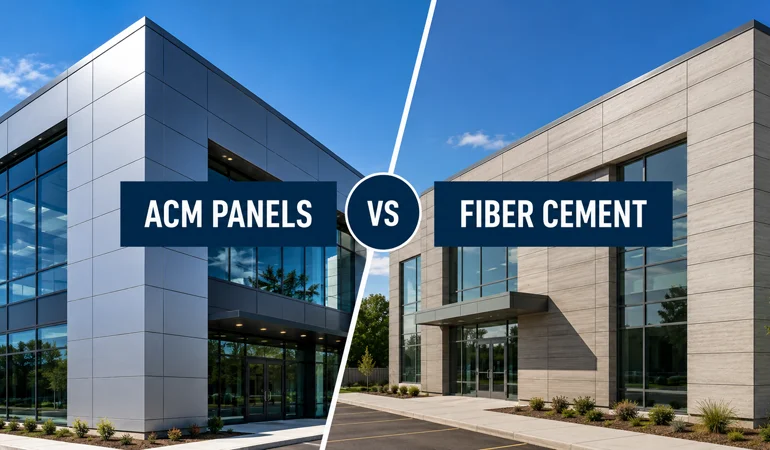
When it comes to selecting cladding for commercial buildings in Canada, two materials consistently rise to the top of the shortlist: Aluminum Composite Material (ACM) panels and fiber cement boards. Both are proven performers across Ontario’s office buildings, retail centres, healthcare facilities, and mixed-use developments. However, they behave very differently under our harsh climate, varying budgets, and architectural demands.
This guide breaks down how ACM and fiber cement compare across the factors that matter most to Canadian developers, architects, and property owners.
Understanding the Two Materials
ACM panels are engineered composites made of two thin aluminum sheets bonded to a non-aluminum core, typically a fire-retardant mineral or polyethylene blend. They are lightweight, rigid, and available in virtually unlimited finishes — from solid colours and metallics to wood and stone replicas.
Fiber cement, on the other hand, is a denser, heavier panel manufactured from Portland cement, cellulose fibres, sand, and water. According to the Canadian Wood Council and ASTM standards referenced by Natural Resources Canada, fiber cement is recognized as a non-combustible product widely used for both residential and commercial applications.
Performance in the Canadian Climate
Canadian weather is brutal on building envelopes. Freeze-thaw cycles, heavy snow loads, ice damming, summer UV exposure, and salt-laden air near the Great Lakes all test cladding materials year-round.
Here is how each material handles our climate:
- ACM panels: Excellent dimensional stability across temperature swings, with minimal expansion and contraction. The aluminum skin resists corrosion, and modern PVDF coatings hold colour for 20+ years.
- Fiber cement: Highly resistant to moisture and rot, but heavier panels can be vulnerable to micro-cracking over many freeze-thaw cycles if installation tolerances aren’t precise.
- Wind and impact: ACM performs well against wind loads thanks to its rigid yet flexible structure, while fiber cement offers superior resistance to physical impacts like flying debris.
For a deeper look at how panel colour also affects climate performance, see our guide on dark vs. light cladding colours in Canadian climates.
Fire Safety and Building Code Compliance
Fire safety is one of the most discussed topics in commercial cladding today, especially in the wake of code updates across Ontario. The National Building Code of Canada requires non-combustible cladding for many mid- and high-rise commercial occupancies.
A few key points to keep in mind:
- Fiber cement is inherently non-combustible and easily meets CAN/ULC-S114 standards.
- ACM panels must be specified with a fire-retardant (FR) or A2 mineral core to comply with CAN/ULC-S134 full-scale wall assembly tests.
- Polyethylene-core ACM (PE) is generally not permitted on commercial buildings over three storeys in Canada.
Choosing the right grade of ACM is essential — and this is where working with experienced suppliers matters. Buildsky’s consultation services help architects and contractors confirm code compliance before specification.
Aesthetic Flexibility and Design Options
Commercial buildings increasingly rely on cladding to reinforce brand identity and architectural intent. This is one area where ACM has a clear advantage.
ACM offers:
- A virtually unlimited palette of solid, metallic, mica, sparkling, and pattern finishes
- Realistic wood-grain and stone-look textures without the maintenance burden
- Sharp, seamless joints and large continuous panel sizes for modern minimalist façades
- Easy fabrication into curved, folded, or perforated shapes
Fiber cement, while increasingly versatile, is typically limited to flat planks, large-format panels, and a more restrained colour range. It excels at delivering a clean, modern, or natural-textured look but cannot match the metallic sheen or sculptural fabrication possibilities of aluminum composite panels.
Weight, Installation, and Project Timelines
Weight is a critical factor in commercial projects because it influences structural design, hoisting requirements, and labour hours.
- ACM panels typically weigh 5–8 kg/m², making them ideal for high-rise applications and retrofit projects where structural loads are constrained.
- Fiber cement weighs 15–25 kg/m² depending on thickness, which can require reinforced subframes and slower installation.
- Cutting and shaping: ACM can be routed, folded, and seamed on site, while fiber cement requires diamond blades and dust-control equipment.
Faster installation generally translates to lower labour costs and shorter project schedules — both important for commercial developers working under tight deadlines. Explore our professional cladding installation services for project-specific guidance.
Cost Comparison Over the Life of the Building
Upfront pricing only tells part of the story. The real comparison is total cost of ownership over a 20–30 year service life.
- Material cost: Fiber cement is generally less expensive per square foot upfront, while ACM sits in the mid-to-premium range.
- Installation cost: ACM’s lighter weight and faster handling often narrow the overall installed price gap considerably.
- Maintenance: ACM requires only occasional washing; fiber cement may need periodic repainting and sealant inspections.
- Lifecycle value: Both materials can last 30+ years when installed correctly, but ACM typically retains its appearance with less intervention.
Sustainability and Recyclability
Sustainability is a growing priority for Canadian developers pursuing LEED, Zero Carbon, or Toronto Green Standard certifications.
ACM panels are highly recyclable — aluminum can be recovered and reused indefinitely without loss of quality. Fiber cement, while made from abundant raw materials, is more energy-intensive to produce and harder to recycle at end of life. For a broader perspective, read our article on sustainable cladding choices and environmental impact.
Which Material Is Right for Your Project?
There’s no universal winner — the right choice depends on your building’s height, budget, design goals, and exposure conditions.
Consider ACM panels when you need:
- A modern, sleek, or metallic aesthetic
- Lightweight cladding for high-rise or retrofit work
- Fast installation timelines and flexible fabrication
Consider fiber cement when you need:
- A natural, wood-look, or matte finish at a lower upfront cost
- Maximum impact resistance for low-rise commercial buildings
- Long maintenance intervals with a traditional appearance
Both materials are excellent — what matters most is correct specification, code-compliant detailing, and skilled installation. Buildsky’s team supplies, fabricates, and installs both ACM and other premium cladding systems across the GTA. Contact us at (647) 818-4683 or visit our office at 364 Supertest Rd., Unit 205, North York, ON M3J 2M2 to discuss your next commercial project, or request a quick quote online.
