

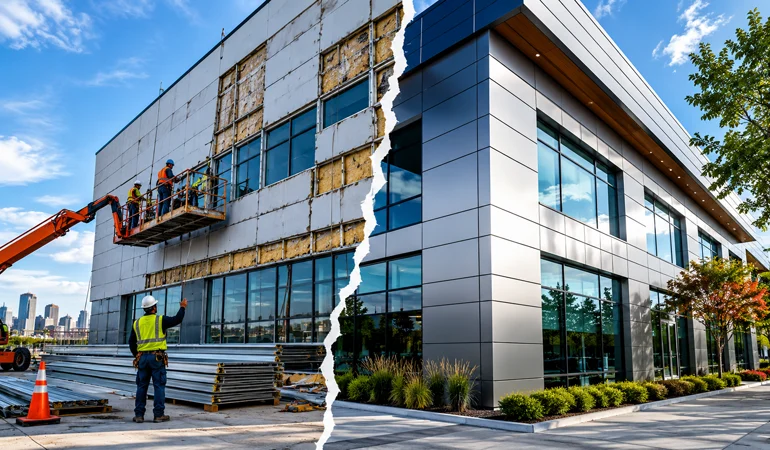
Your building’s cladding does more than create curb appeal — it protects the structure from moisture infiltration, thermal movement, and the demanding freeze-thaw cycles of Ontario winters. When problems appear, the decision isn’t always straightforward: do you repair what you have, or invest in a full re-cladding?
This guide walks commercial property owners and building managers through the key factors that drive that decision.
Start with a Proper Assessment
Before anything else, you need an honest picture of the cladding’s current condition. Surface-level deterioration — fading, minor dents, isolated sealant failures — can often be addressed with targeted repairs. But many problems visible on the exterior are symptoms of deeper issues.
A professional condition assessment should examine:
- The substrate and framing behind the panels
- Moisture infiltration and signs of water damage or mould
- Fastener and bracket integrity
- Fire performance compliance, especially for older ACM/ACP systems
- The extent of corrosion, delamination, or panel failure
If issues are isolated to less than 15–20% of the cladding area, repair is typically the more cost-effective path. Beyond that threshold, cumulative repair costs often approach or exceed re-cladding — without delivering the same long-term result.
Signs That Repair Is Sufficient
Not every cladding problem warrants a full replacement. Repair makes sense when:
- Damage is localized — a few panels damaged by impact, vandalism, or weather
- The system is relatively new — less than 10–12 years old and otherwise performing well
- Sealant or joint failure is the primary issue, with the panels themselves intact
- Colour matching is feasible — replacement panels can be sourced to match existing ones
For aluminum siding and composite panel systems, individual panel replacement is often straightforward when the substructure is sound. BuildSky’s cladding fabrication service can produce custom replacement panels to match your existing profile and finish precisely.
Signs That Re-Cladding Is the Right Call
There are situations where repair simply extends the inevitable — and delays a more strategic investment. Re-cladding becomes the right decision when:
- Widespread delamination or corrosion affects the majority of panels
- The system is aging — 20+ years and showing systemic failure, not isolated incidents
- Fire compliance is a concern — older non-FR (fire-retardant) ACM cores may no longer meet current Ontario Building Code requirements
- Moisture has compromised the substrate — structural remediation is required regardless
- The building is undergoing a major renovation — re-cladding alongside other upgrades is the most cost-efficient time to act
Ontario’s Building Code sets clear performance standards for exterior cladding systems, particularly around fire resistance and moisture management. If your existing cladding doesn’t meet current requirements — especially on buildings over three storeys — a re-cladding project isn’t just a cosmetic upgrade, it’s a compliance issue. You can review the applicable requirements through the Ontario Building Code.
The Financial Lens: Total Cost of Ownership
One of the most common mistakes property owners make is comparing the upfront cost of repair against the upfront cost of re-cladding, without factoring in total cost of ownership.
Ask your team to model:
- Ongoing maintenance costs over a 10-year horizon if you repair now
- Energy performance gains from a new insulated cladding system
- Deferred liability — water infiltration damage to structure and interiors compounds quickly
- Property value and tenant appeal — modern cladding systems have a measurable impact on commercial property valuation
A professional cladding consultation is often the most cost-effective first step. A specialist can help you build a defensible business case — whether the decision goes toward repair or full replacement.
Consider the Cladding System, Not Just the Panels
The re-clad vs. repair decision also depends heavily on what system you’re dealing with. Some older dry-joint or wet-seal systems have reached end-of-life for their sealant chemistry, regardless of panel condition. Rainscreen systems, by contrast, are more durable and easier to partially repair because they allow air circulation and drainage behind the panels.
If you’re re-cladding, it’s also the ideal opportunity to upgrade to a more resilient system. Modern ACM, aluminum profile, or fiber cement rainscreen assemblies offer dramatically improved moisture management, thermal performance, and design flexibility compared to systems installed 15–20 years ago. For a closer look at how different materials compare, see our article on aluminum composite panels vs. other exterior metal claddings.
When to Involve a Specialist
The re-clad vs. repair decision carries real financial and legal weight for commercial properties. If you’re managing a multi-unit residential building, a mixed-use commercial block, or an industrial facility in the GTA, the stakes are high enough that a qualified cladding contractor should be involved early — before scopes are set and costs are committed.
BuildSky works with property owners, building managers, and general contractors across North York and the GTA to assess existing cladding systems, develop remediation strategies, and execute both repair and re-cladding projects. Reach out to our team at (647) 818-4683 or visit us at 364 Supertest Rd Unit 205, North York, ON M3J 2M2 to discuss your building’s needs.
You can also learn more about our full range of services — from cladding design and fabrication to professional installation — on our services pages.
