

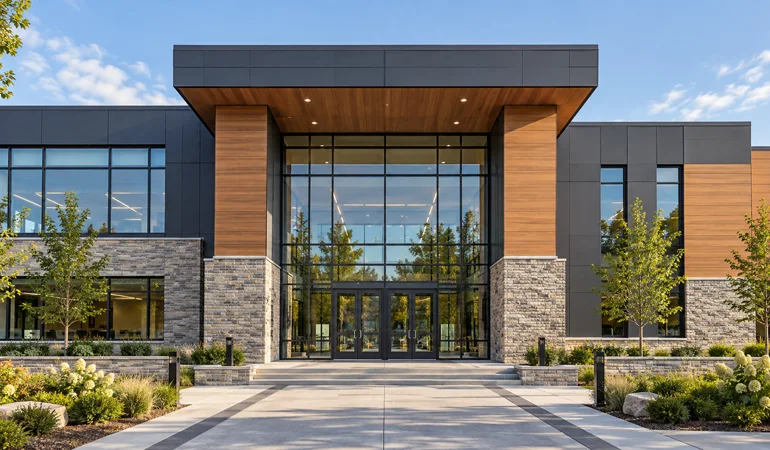
Town halls, libraries, recreation centres, schools and regional offices are built to serve communities for 50 years or more. Their exteriors face a tougher brief than most private buildings: they must look welcoming, survive heavy public use, meet strict code requirements and stand up to taxpayer scrutiny on cost.
Choosing the right cladding is a big part of meeting that brief. This guide covers what public-sector owners, architects and general contractors should consider when selecting and delivering cladding for municipal and institutional projects in Ontario.
What Makes Public Buildings Different
A private developer may plan to sell a building within a decade. A municipality or school board will often own and maintain the same facility for generations, so decisions are judged on lifecycle value rather than upfront price.
Public projects also come with extra layers of oversight. Expect these factors to shape the cladding decision:
- Long service life: Materials are expected to perform for decades with minimal replacement.
- Heavy public use: Ground-level walls face impact, scuffs, graffiti and salt spray.
- Civic identity: The facade should reflect the community it serves.
- Fixed opening dates: Schedules are often tied to council approvals, ribbon cuttings or a season’s start.
- Transparent procurement: Material choices must be clearly specified and defensible.
Choosing Materials for Durability and Low Maintenance
Maintenance budgets for public facilities are usually tight, so cladding that needs repainting, sealing or frequent repairs becomes a long-term burden. Panel systems with factory-applied finishes typically offer the best balance of appearance and upkeep.
The most common choices on Ontario institutional projects include:
- ACM panels: Crisp, modern finishes in nearly any colour, ideal for canopies, fascias, soffits and window surrounds.
- Wood composite panels: The warmth of timber without staining or rot, popular for community buildings and main entrances.
- HPL panels: Dense and highly impact-resistant, well suited to schools and high-traffic ground floors.
- Aluminum plate and natural metal panels: Premium, long-lasting options for landmark civic buildings.
- Stone veneer: Often paired with metal panels to create a solid, grounded base.
Code Compliance and Fire Safety
Many municipal and institutional buildings are classified as assembly or care occupancies under the Ontario Building Code, which can bring tighter requirements for exterior wall assemblies. Building height, occupancy type and limiting distance all influence whether combustible cladding is permitted and what testing is required.
Getting this right early avoids costly redesigns during permit review. Our guide to how OBC requirements shape cladding material selection explains the key provisions, including CAN/ULC-S134 assembly testing and the role of fire-retardant and mineral-core panels.
Designing Facades That Reflect the Community
A public building’s exterior is often the first impression residents have of their local government or school. Good facade design makes the entrance easy to find, creates a sense of welcome and gives the building a recognizable identity.
Proven design strategies for civic buildings include:
- Warm materials at the entrance: Wood-look panels or soffits that draw visitors in
- Contrasting frames: Darker metal panels that outline windows, canopies and entry bays
- Covered entries: Canopies with clean soffits that shelter visitors in winter
- Wayfinding alignment: Panel joints and colours that line up with signage and glazing
Real Ontario Examples
At the Halton Regional Centre in Oakville, BuildSky combined textured wood-grain composite panels in a staggered plank pattern with matte charcoal ACM framing the window bays and canopy edges. Honey-tone concealed-fastener aluminum soffits finish the main entrance portico, and 3D renderings were used to align panel layouts with wayfinding and glazing.
At Stouffville Memorial Park & Skating Trail, grey ACM panels and matching ACM soffits were paired with natural stone veneer walls. Concealed-fastener soffits give the sheltered skate entryways a clean ceiling, and installation was coordinated to meet the trail’s December 2024 soft launch. You can see more examples on our commercial projects page.
Navigating Public Procurement and Schedules
Public projects are usually delivered through competitive tenders. School boards, colleges, universities and hospitals follow Ontario’s Broader Public Sector Procurement Directive, while municipalities tender under their own procurement bylaws.
For cladding contractors and suppliers, success on these projects depends on a few essentials:
- Clear submittals with product data, test reports and warranties
- Accurate shop drawings coordinated with the architect’s details
- Reliable lead times that support fixed opening dates
- Strong communication with the general contractor and municipal planners
Planning for the Full Lifecycle
When evaluating cladding options, public owners should look beyond the bid price. A system that costs more upfront but avoids repainting, panel replacement or water damage repairs often delivers better value over 30 to 50 years.
Ask these questions when comparing systems:
- What is the manufacturer’s finish and material warranty?
- How easily can a damaged panel be replaced?
- What routine maintenance is required each year?
- Does the system include a ventilated rainscreen to manage moisture?
- What environmental data, such as EPDs, is available for sustainability targets?
For more on balancing performance and environmental goals, see our article on sustainable commercial cladding choices.
Partner With BuildSky on Your Next Public Project
BuildSky works with architects, general contractors and municipal planners on civic and institutional facades across Ontario. Our consultation services help teams select compliant materials early, and our in-house fabrication delivers CNC-cut panels built to exact tolerances and schedules.
To discuss your project, call us at (647) 818-4683 or visit our office at 364 Supertest Rd Unit 205, North York, ON M3J 2M2.
